
Relationships as Learning Engines


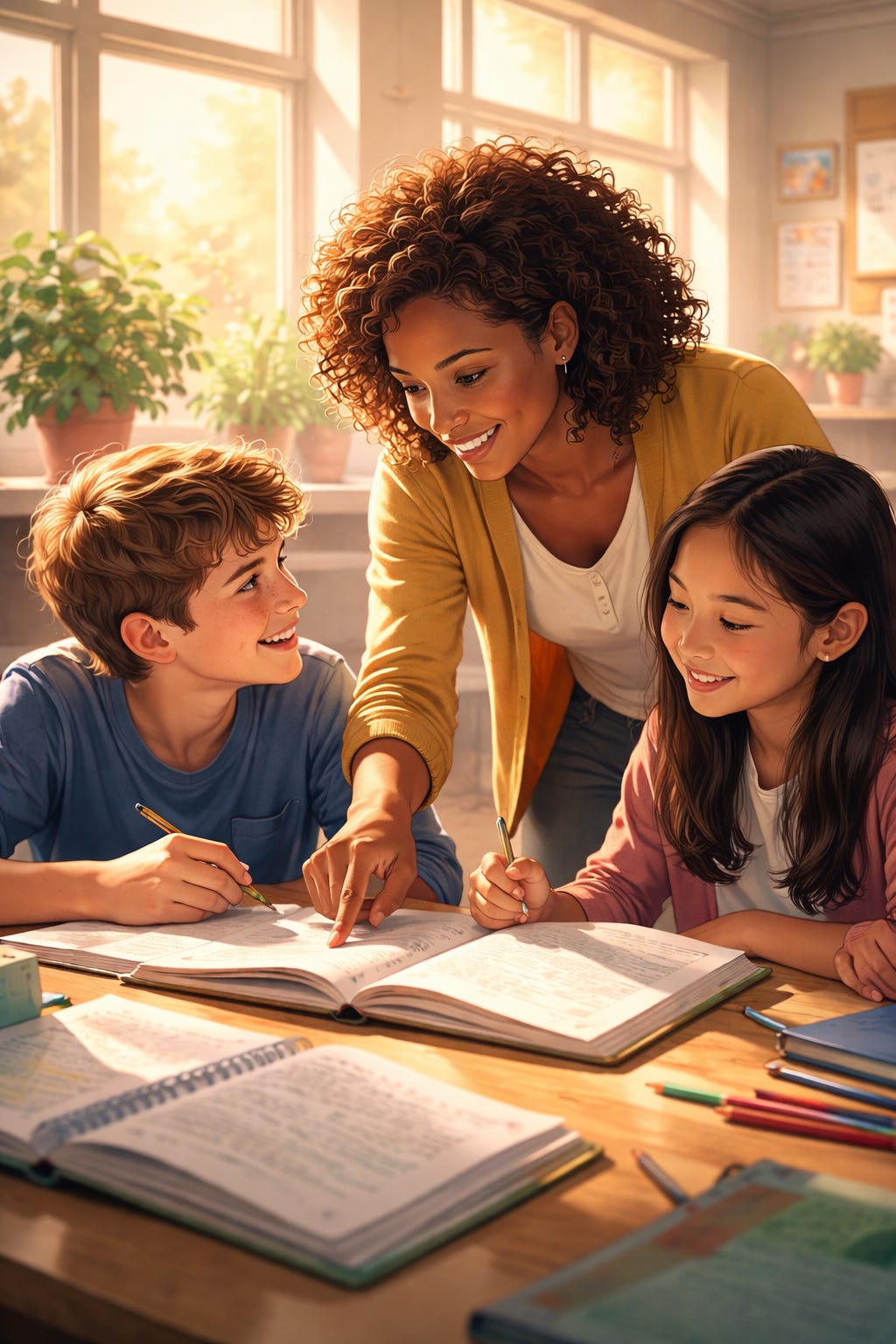
Nobody Grows Alone
A baby doesn’t learn to walk by reading instructions. They wobble forward, fall, reach for a parent’s hand, get steadied, and try again.
A teenager doesn’t discover resilience in isolation. They test boundaries, clash with authority, lean on friends, collapse, get lifted, and adapt.
Growth happens in relationship. Always.
Yet much of education has been built as if learners are solitary climbers on a ladder—each advancing alone, with the teacher as a scorekeeper. Spiral We flips this script:
Relationships aren’t side notes to growth.
They are the engines of it.
Adaptive Connection Is Relational
Adaptive Connection is never just about “fixing” an individual learner. It lives in the reciprocal dance between people.
A teacher notices dysregulation and softens expectations.
A parent shifts routines when a child’s anxiety spikes.
A peer interprets silence as protection, not rudeness.
Each moment is a micro-adjustment in relationship.
Each one subtly changes a learner’s trajectory.
Learning is not housed only in neurons.
It is distributed across relationships.
Co-Regulation: Borrowed Calm
One of the most powerful relational tools in learning is co-regulation.
When a learner’s nervous system is overloaded, they borrow stability from someone else’s calm. A teacher’s steady tone. A parent’s grounding presence. Even a peer’s quiet nod.
This is not metaphor.
It is biology.
Relational safety reduces stress hormone activity, allows the prefrontal cortex to re-engage, and reopens access to learning (Porges, 2011; Siegel, 2012).
Safety does not come from words on a chart.
It comes from being held in relationship.
Relationships in Context
Psychologist Urie Bronfenbrenner’s bioecological model helps us see why relationships matter at more than one level (Bronfenbrenner & Morris, 2006).
Microsystem: family, classroom, peers
Mesosystem: interactions between those microsystems
Macrosystem: culture, policy, societal norms
Adaptive Connection works at every layer.
A single teacher–student relationship matters.
So does the ecology of relationships surrounding that learner.
The web is the learning environment.
Human + AI Partnerships as Relational Extension
Relationships don’t stop at human boundaries.
As explored earlier in this series, the problem-solving loop can be distributed across partners, including artificial intelligence.
Humans bring intuition, lived context, values, and anomaly-detection.
AI brings rapid micro-research, pattern recall, and structured memory.
Together, they co-iterate.
A teacher notices tension.
AI surfaces possibilities.
The teacher adapts in context.
This is not replacement.
It is relational extension—expanding capacity without displacing the human core.
A Story of Being Seen
Consider Sam, a nine-year-old who constantly interrupted lessons with “random” facts. Teachers labeled him disruptive.
One teacher paused and shifted lenses.
She noticed that Sam’s facts were connected to the lesson. He wasn’t derailing.
He was seeking entry.
She restructured discussions so curiosity had a place at the beginning. Interruptions dropped. Engagement soared.
What changed was not Sam.
What changed was the relationship.
Being seen differently allowed him to learn differently.
Why This Matters
When learning is framed as individual achievement, we miss its true engine.
When relationships are treated as scaffolds rather than distractions, we see that growth is not built on independence first—but on interdependence.
Adaptive Connection reminds us:
We don’t grow alone.
We grow together—spiraling upward through shared noticing, shared regulation, and shared iteration.
In the weeks ahead, we’ll see how scholars like Donna Ford, Janice Hale, and Gloria Ladson-Billings show what happens when systems honor—or ignore—this relational engine.
A Reflection for You
Think of someone who saw you accurately—a teacher, mentor, friend, or even a stranger.
What did they notice that others missed?
How did that shift your growth?
What changed in you because of that connection?
References
Bronfenbrenner, U., & Morris, P. (2006). The bioecological model of human development. Handbook of Child Psychology.
Porges, S. W. (2011). The Polyvagal Theory. Norton.
Siegel, D. J. (2012). The Developing Mind. Guilford Press.
Vygotsky, L. S. (1978). Mind in Society. Harvard University Press
Let me propose to you that the interconnections between relationships and growth/learning engines are not linear much as development is not linear. Indeed, consider that relationships are spiral as are learning engines. Indeed, growth patterns psychologically (including learning) are akin to growth patterns physically: more spiral in shape than linear. The more professionals from all walks of life being to grasp the fact that all aspects of human development (again, including relationships and learning) are spiral in character, the better poised those professionals will be to offer guidance and interventions that align with the overall developmental spiral trajectories that comprise human growth.