
Why Brilliant Students Sometimes Suddenly Struggle
What asynchronous development helps us see


Editor’s Note: Spiral We is beginning to introduce occasional paid posts to support the continued development of research-informed writing, reflective tools, and educator resources. Most essays will remain free, while selected deeper-dive pieces will support the sustainability of the publication.
One of the most common concerns educators and parents express about gifted learners sounds deceptively simple:
“They’re so inconsistent.”
A student writes with astonishing depth one week and cannot begin an assignment the next. A learner who speaks with insight beyond their years melts down over a small change in routine. A child who appears deeply engaged in one setting becomes withdrawn, avoidant, or emotionally flooded in another.
To adults, it can feel confusing.
If a learner is capable, shouldn’t they be able to perform consistently?
Schools are built around that assumption.
We expect development to move in relatively synchronized ways. If cognitive ability is advanced, we unconsciously expect emotional regulation, task initiation, organization, frustration tolerance, and social functioning to advance alongside it.
So when those things diverge, adults begin searching for explanations:
Lack of motivation
Executive functioning problems
Emotional dysregulation
Anxiety
Behavioral issues
Laziness
Avoidance
Sometimes those explanations are partially true.
But often they are incomplete.
Because they all assume that performance exists entirely inside the learner.
The Pattern Beneath the Pattern
A developmental systems perspective tells a different story.
Performance is never simply the product of ability. It emerges through an interaction between:
the learner,
the environment,
the task,
the relationships present,
and the learner’s current regulatory state.
Change any one of those conditions, and performance can shift dramatically.
From this perspective, inconsistency is not surprising at all.
It is expected.
What adults often call “inconsistency” may actually reflect a pattern we have not yet learned how to interpret.
A learner who writes beautifully at home but freezes in class.
A student who participates verbally but avoids written tasks.
A child who thrives one-on-one yet shuts down in groups.
A learner who demonstrates advanced insight during discussion but cannot begin independent work.
These are not contradictions.
They are signals.
They reveal where alignment exists—and where it breaks down.
The Part We Often Miss
Most schools still operate from a model of synchronized development.
If a learner demonstrates advanced reasoning, adults often expect emotional maturity, organizational capacity, self-regulation, and social adaptability to develop alongside it.
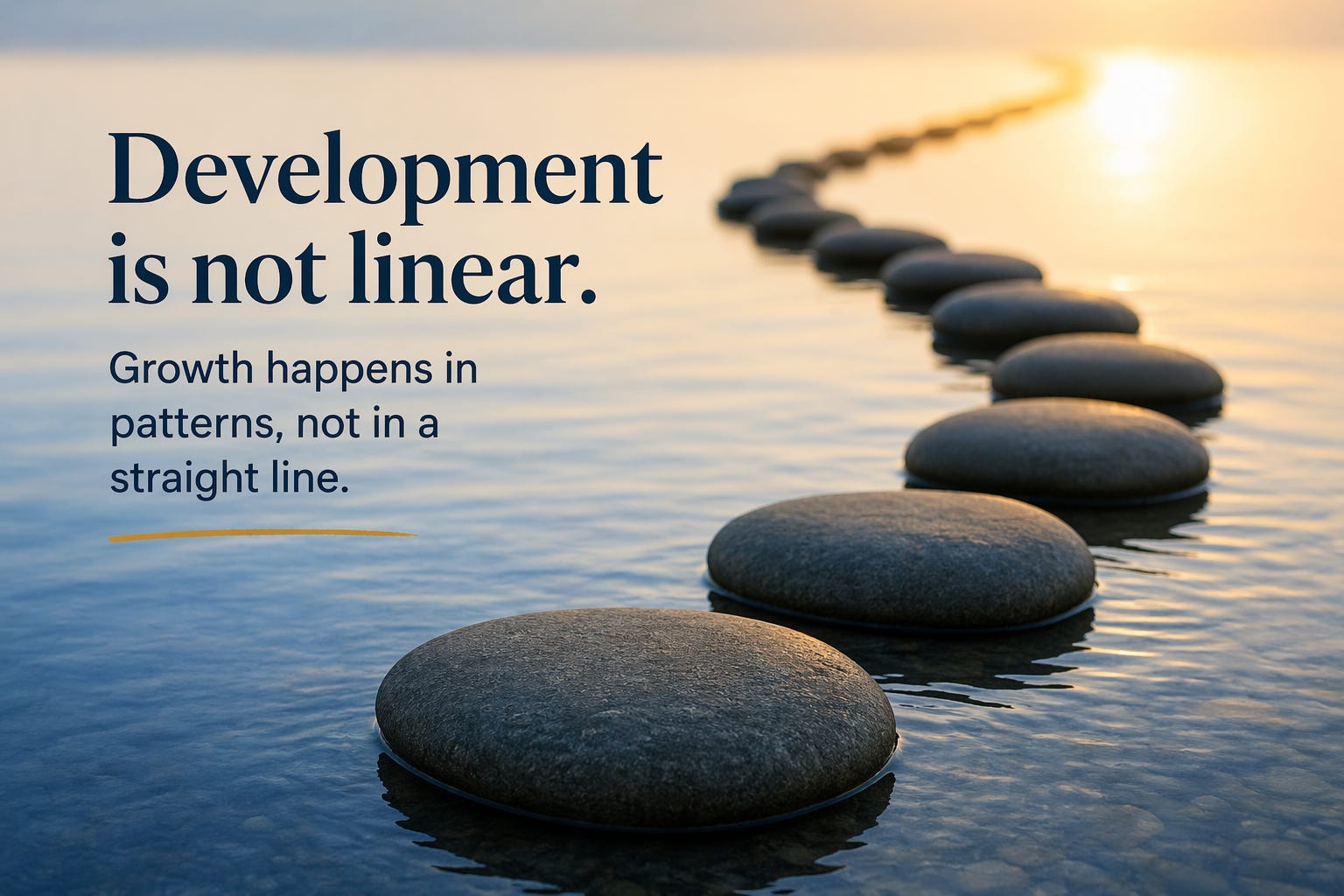
But many gifted and neurodivergent learners do not develop evenly across domains.
A learner may think years ahead of their peers while regulating emotions much closer to their chronological age.
Another may demonstrate extraordinary verbal sophistication while struggling with transitions, sensory overload, or task initiation.
A student may appear highly capable in emotionally safe environments and significantly less functional under stress, uncertainty, or public evaluation.
From the outside, these shifts can look inconsistent—even manipulative.
But developmental research on asynchronous growth suggests something different: unevenness is not necessarily dysfunction. It is often the natural shape of development itself (Silverman, 1997; Giedd et al., 1999).
And when adults misinterpret these mismatches, learners frequently internalize shame for developmental patterns that were never failures to begin with.
