
Why Some Learners Adapt Until They Disappear
When the Lesson Stops Being the Lesson


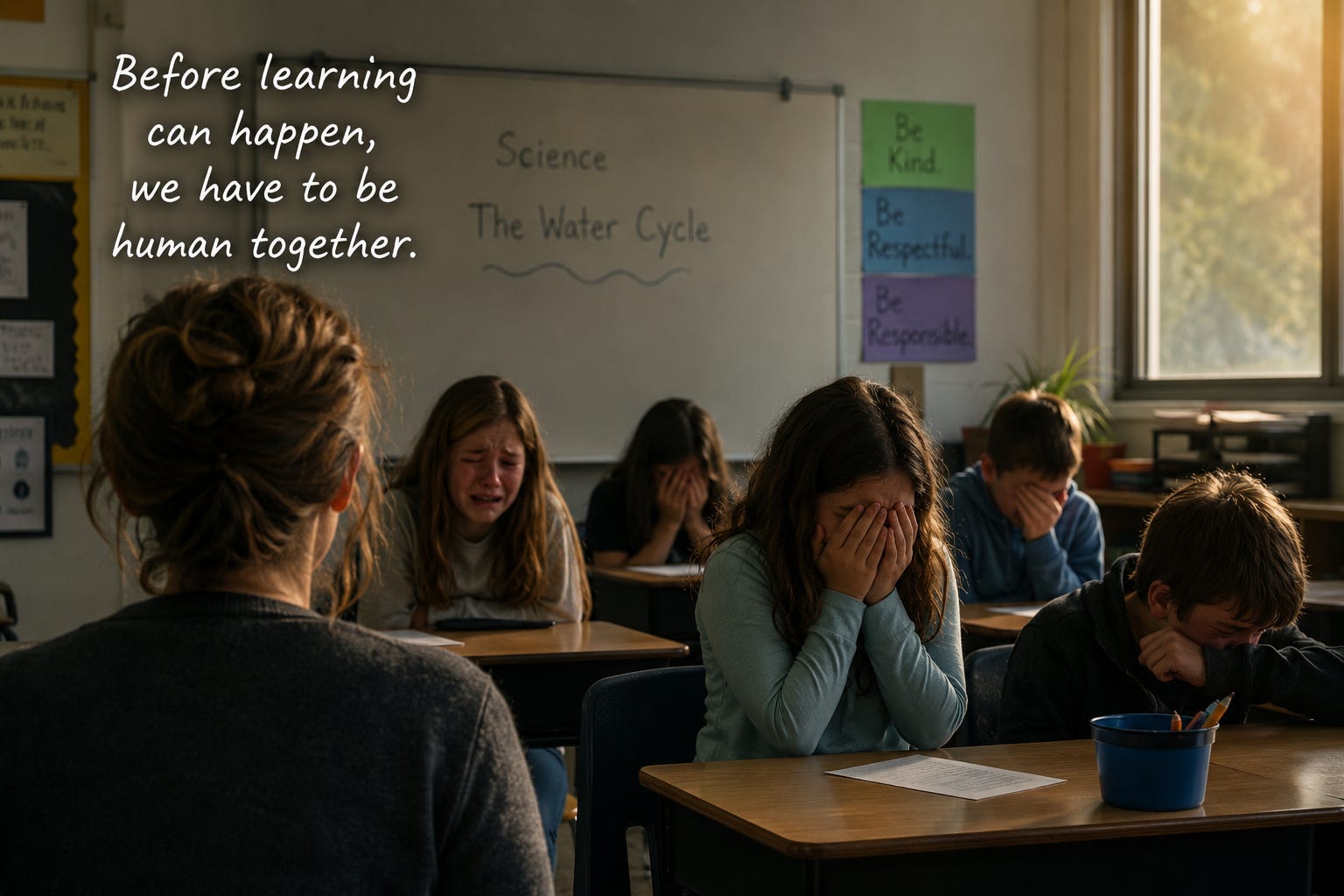
Toward the end of my student teaching in a fifth grade classroom, I remember preparing to teach a science lesson that I was genuinely excited about. Science was always one of my favorite subjects to teach because students usually arrived curious, excited, and ready to engage. I had my materials ready, the lesson planned, and the room settled after lunch recess on a Friday afternoon.
Then one student started crying.
A few moments later, another student started crying too. Then another. Before I fully understood what was happening, most of the class was visibly upset. I had never seen anything like it before. Nearly three-quarters of the classroom was in tears.
Eventually, I learned the students were terrified about a classmate who had been struggling emotionally and cutting herself. They were afraid she might hurt herself over the weekend.
The science lesson stopped immediately.
I called the office for support, and a counselor came to help. Looking back now, I realize that moment changed something fundamental in how I understood teaching, learning, and classroom life.
At the time, I do not think I had the language for regulation yet. But I understood something important instinctively: no amount of good instruction could compete with the emotional reality unfolding in that room.
The students were physically present, but cognitively and emotionally, they were somewhere else entirely.
Regulation Before Cognition
For many years, educational systems have often treated behavior, emotion, and cognition as though they operate separately from one another. Students are expected to focus, participate, write, collaborate, and learn regardless of what may be happening emotionally beneath the surface.
But the more I taught, researched, and observed classrooms, the more difficult that separation became to maintain.
Relationships began to matter differently to me. Transitions mattered differently. Classroom rhythms mattered differently. I started noticing how dramatically emotional states affected writing, participation, discussion, flexibility, and even students’ ability to access thinking itself.
This became especially visible while working with gifted and twice-exceptional learners. Some students could discuss complex philosophical ideas far beyond grade level while simultaneously struggling with perfectionism, emotional regulation, social pacing, or executive functioning. Others appeared disengaged academically when they were actually overwhelmed, anxious, or emotionally flooded.
Over time, I realized that many educational systems mistake compliance for readiness.
A quiet classroom is not always a regulated classroom. A student sitting still is not necessarily emotionally available for learning. Even participation itself can become misleading. Some students over-participate because they are anxious. Others withdraw because speaking publicly feels emotionally exposing.
Once regulation becomes the lens, classrooms begin to look very different.
What Changed Once I Saw It Differently
One of the most surprising things about understanding regulation more deeply is that it made me a calmer educator.
Earlier in my teaching journey, I think I sometimes viewed classroom difficulties primarily through instruction, behavior, or effort. If students were disengaged, I assumed I needed a more interesting lesson. If participation was uneven, I focused on strategies for accountability. If students struggled emotionally, I often saw those struggles as interruptions to the “real” work of teaching - delivering curriculum.
Over time, that changed.
Relationships had to take priority over curriculum because regulation shaped whether students could meaningfully access the curriculum in the first place.
Ironically, once I stopped viewing emotional and relational needs as competing with learning, the learning itself often improved. Students wrote more authentically when they felt safer taking intellectual risks. Discussions became richer when students trusted they would not be humiliated for uncertainty or mistakes. Group participation improved when classrooms felt emotionally predictable rather than socially threatening.
I saw this repeatedly in writing instruction. Students often struggled less with writing mechanics than with the emotional vulnerability writing required. Writing exposes uncertainty. It exposes unfinished thinking. It forces students to confront the uncomfortable space between what they want to say and what they can currently express clearly.
Many students are not simply avoiding writing.
They are avoiding exposure.
Regulation Is Ecological
The longer I teach, the harder it becomes to think about learning as an isolated cognitive process.
Classrooms are ecosystems. So are workplaces. So are families and relationships. Human beings constantly respond to environments, emotional cues, rhythms, uncertainty, social dynamics, and the nervous systems around them.
Some of the most effective teachers I have ever observed were not necessarily the loudest, strictest, or most charismatic. They were often the most emotionally steady. They created predictable transitions, clear routines, emotionally safe participation structures, and environments where students could remain connected to both themselves and the learning process.
This is one reason I struggle with educational narratives that reduce success primarily to grit, effort, or willpower. Persistence certainly matters, but positive psychology and affective research repeatedly remind us that emotional state influences cognition far more than many systems acknowledge.
People generally think more clearly when they feel emotionally safe, connected, and regulated.
That is true for children.
It is also true for adults.
Why Regulation Changes Everything
Once regulation becomes part of the lens, it becomes difficult to see classrooms the same way again.
Behavior is no longer interpreted only as compliance or defiance. Participation is no longer automatically interpreted as engagement. Silence is no longer automatically interpreted as readiness. Emotional reactions stop looking like isolated disruptions and begin looking more like information about the relationship between people and environments.
Even maturity begins to look different.
Development is rarely linear. A student may demonstrate remarkable intellectual sophistication while still struggling emotionally, socially, or behaviorally in moments of stress. Adults do this too.
Regulation changes everything because it changes what we notice.
It changes how we interpret behavior, how we structure environments, how we respond to emotional distress, how we approach learning, and how we understand human development itself.
Most importantly, it reminds us that teaching has never been only about delivering curriculum.
It has always been about human beings learning in relationship with other human beings.
References
Bronfenbrenner, U., & Morris, P. A. (2006). The bioecological model of human development. In Handbook of Child Psychology.
Fredrickson, B. L. (2001). The role of positive emotions in positive psychology: The broaden-and-build theory of positive emotions.
Prizant, B. (2015). Uniquely human: A different way of seeing autism.